

Best overall: full-service weekly care. Best for hands-on owners: chemistry-only visits. Best for owners managing water chemistry: cleaning-only visits. Best for absent owners: documented full-service care. This 2026 guide compares service scopes—not named provider packages—so you can choose weekly pool care by what gets done.
- For weekly pool service plans Arizona homeowners compare, full-service care is the default recommendation for reducing routine work.
- Chemistry-only visits suit owners who handle brushing, debris removal, and other cleaning between visits.
- Cleaning-only visits suit owners who already manage water testing and chemical adjustments.
- Taskgenie provides pool cleaning in Buckeye and surrounding areas; confirm the weekly scope before booking.
Why this matters
A weekly visit describes frequency, not coverage. A technician can check water chemistry without brushing the walls, or remove debris without taking responsibility for chemical adjustments. Those are different services, even when both appear under pool maintenance.
Taskgenie provides residential and commercial pool cleaning in Buckeye, Arizona, and surrounding areas. Taskgenie is best suited to Buckeye-area homeowners seeking a local pool-cleaning provider. Ask which recurring tasks a proposed agreement includes rather than assuming the company offers any particular package described below.
Your 2026 decision should start with responsibility: what will the provider handle, and what remains yours? Choose the scope that leaves no essential maintenance task unassigned.
What makes the best weekly pool service plan?
Compare written responsibilities before choosing a service. These criteria separate a useful maintenance agreement from a visit with an unclear purpose:
- Water chemistry: Identify who tests the water, adjusts sanitizer and pH, and records the results.
- Physical cleaning: Specify surface skimming, wall and step brushing, basket emptying, and vacuuming responsibilities.
- Equipment checks: Define what gets observed, what gets reported, and whether any repair work requires separate authorization.
- Filter maintenance: Clarify whether filter cleaning is included, separately scheduled, or the homeowner's responsibility.
- Visit documentation: Request a clear account of completed work, measurements, and problems needing attention.
- Between-visit care: Assign responsibility for debris, water level, and problems that develop before the next appointment.
The best plan covers the work you cannot reliably handle yourself. A longer task list is not automatically better if it duplicates work you already do while leaving another responsibility unclear.
Weekly pool service plans at a glance
These are comparison categories for evaluating proposals, not standardized industry packages. The documented full-service option adds reporting to the full-service scope; it is not a separate cleaning method.
| Rank and service scope | Best for | Standout feature | Key limitation |
|---|---|---|---|
| 1. Full-service weekly care | Owners wanting routine work handled | Combines chemistry and physical cleaning | Filter work, repairs, and extra visits still need clarification |
| 2. Chemistry-only visits | Owners who reliably clean their pool | Assigns testing and chemical adjustment to the provider | Leaves physical cleaning with the owner |
| 3. Cleaning-only visits | Owners who confidently manage water chemistry | Assigns debris removal and brushing to the provider | Does not transfer chemical management |
| 4. Documented full-service care | Owners away from the property | Adds written visit records and issue reporting | Reports do not replace an on-site response between visits |
1. Full-service weekly care: best for reducing routine work
Full-service weekly care combines water testing and chemical adjustment with physical cleaning. For a homeowner who wants fewer routine pool chores, this is the strongest starting point. The written agreement still needs to identify the actual tasks rather than relying on the phrase full service.
Ask whether the visit includes brushing walls and steps, emptying baskets, removing surface debris, and vacuuming when needed. Then separate those tasks from filter maintenance and repair work, which require their own scope.
Full-service weekly care pros:
- Gives chemistry and cleaning a single point of responsibility.
- Reduces the number of routine tasks you must coordinate.
- Makes it easier to discuss water condition alongside visible debris.
- Fits owners who do not want a shared cleaning schedule.
Full-service weekly care cons:
- The label does not establish which tasks are included.
- Weekly attendance does not cover every problem between visits.
- Repairs and filter maintenance need explicit treatment in the agreement.
Best for: Homeowners who want routine cleaning and water chemistry handled together.
For your 2026 shortlist, request a task-by-task description. A clear proposal should distinguish routine maintenance from corrective work rather than treating every pool problem as part of the same visit.
Verdict: Buy full-service weekly care when you want to transfer both cleaning and chemistry responsibilities.
2. Chemistry-only visits: best for hands-on pool owners
Chemistry-only visits assign water testing and chemical adjustment to a provider while you retain physical cleaning. This arrangement fits an owner who regularly skims, brushes, empties baskets, and manages debris but wants help maintaining water chemistry.
The division only works when both sides understand it. Ask which measurements the provider checks and how results are recorded; do not assume a chemistry visit includes vacuuming or equipment maintenance.
Chemistry-only visits pros:
- Establishes a clear owner-provider division of work.
- Lets you retain direct control over cleaning.
- Focuses the provider's responsibility on water testing and adjustment.
Chemistry-only visits cons:
- Leaves brushing, skimming, and other cleaning with you.
- Does not resolve a backlog of debris by itself.
- Requires you to recognize and report changes between visits.
Best for: Owners who already keep up with physical cleaning and want chemical management assigned to a professional.
Before choosing this scope, consider your actual habits—not your intended habits. If brushing regularly slips off your schedule, a chemistry-only agreement leaves that gap in place.
Verdict: Buy chemistry-only visits if you reliably handle the cleaning; skip this scope if you want a hands-off arrangement.
3. Cleaning-only visits: best for chemistry-confident owners
Cleaning-only visits transfer physical cleaning while leaving water testing and chemical management with you. A written scope can specify skimming, brushing, basket emptying, and vacuuming without implying that the provider manages sanitizer or pH.
This is the reverse of chemistry-only service. It suits homeowners who understand their water-care responsibilities but want assistance with the physical work.
Cleaning-only visits pros:
- Removes defined cleaning tasks from your routine.
- Leaves chemical decisions under your control.
- Creates a focused agreement around visible maintenance work.
Cleaning-only visits cons:
- Clean-looking water does not establish adequate disinfection.
- You remain responsible for testing and chemical adjustment.
- Unclear boundaries can leave each party expecting the other to act.
Best for: Homeowners who already manage water chemistry consistently and want help with cleaning.
Write down who responds when the cleaner notices cloudy water, algae, or an equipment concern. Reporting a problem and correcting it are different responsibilities; assign both before service starts.
Verdict: Buy cleaning-only visits only when you are prepared to own the water-chemistry work.
4. Documented full-service care: best for absent homeowners
Documented full-service care combines routine chemistry and cleaning with a written visit record. For homeowners away from the property, the reporting requirement makes the maintenance arrangement easier to supervise.
Request completed-task notes, water-test results, and photographs when they help explain a concern. Confirm that the provider agrees to this reporting scope; it is not an assumed feature of every weekly service.
Documented full-service care pros:
- Gives you a record of work without requiring your attendance.
- Makes unresolved issues easier to track across visits.
- Supports clear repair decisions when you are off-site.
- Separates completed maintenance from recommended corrective work.
Documented full-service care cons:
- A visit report cannot address a problem that develops later.
- Photographs do not replace water measurements or equipment diagnosis.
- Someone still needs responsibility for access and urgent on-site decisions.
Best for: Owners who are away regularly or need maintenance records for someone else managing the property.
In 2026, prioritize useful documentation over a message that simply says service is complete. The record should tell you what happened and what, if anything, requires action.
Verdict: Buy documented full-service care when you cannot regularly inspect the pool yourself.
Make the handoff explicit before the first visit
A good weekly agreement answers the same practical questions every time. Use this sequence to check that the proposed scope matches your property and your willingness to participate.
- Assign cleaning: Identify who brushes, skims, empties baskets, and vacuums.
- Assign chemistry: Identify who tests, adjusts, and records water conditions.
- Define maintenance: Separate routine visits from filter work and repairs.
- Set reporting: Agree on how completed work and concerns are communicated.
- Plan exceptions: Decide who handles access problems, unusual debris, and urgent issues.
Put those responsibilities in writing. A verbal promise to take care of the pool leaves too much room for different expectations.
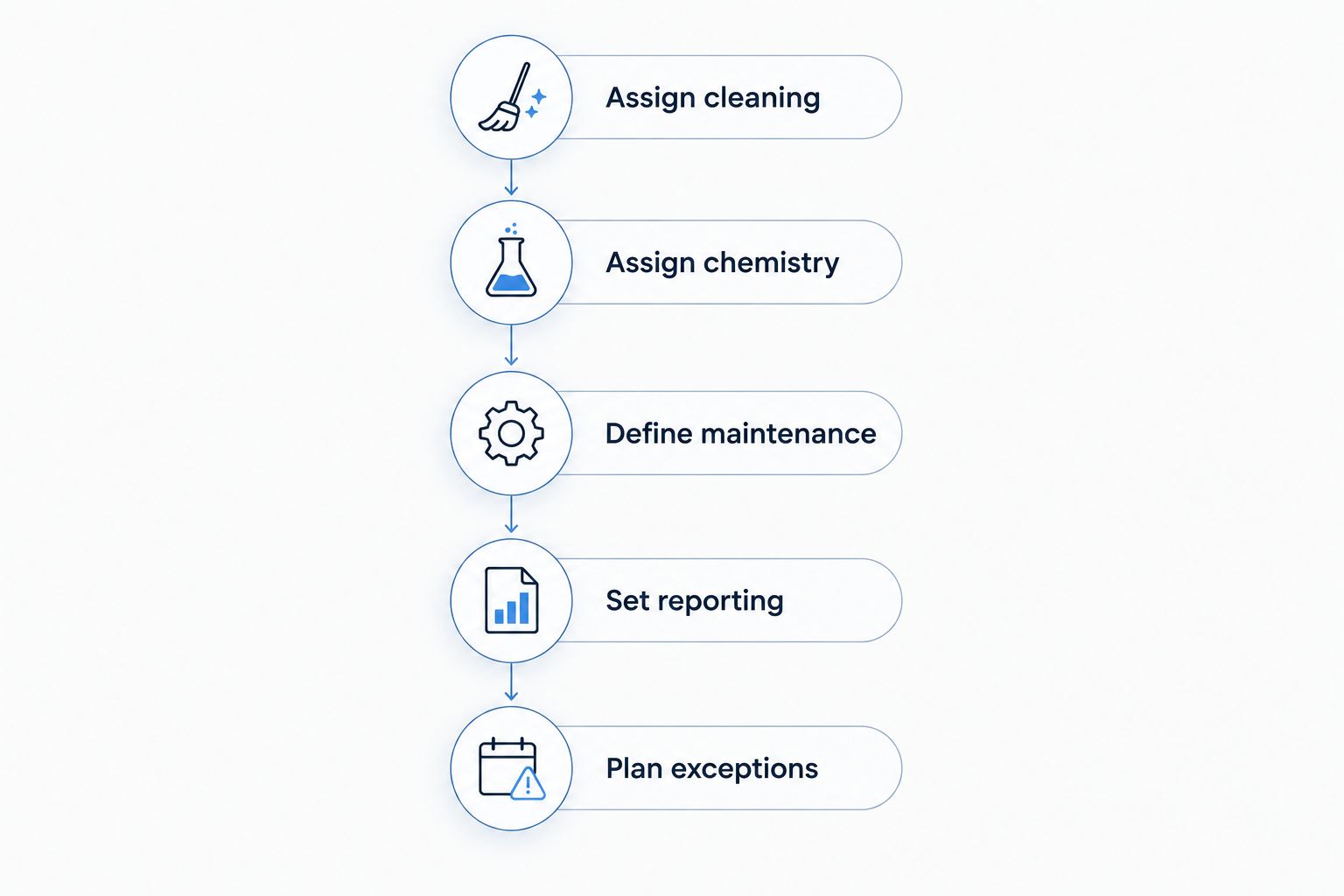
When discussing pool cleaning with Taskgenie, use this checklist to define the requested scope. Ask which tasks the proposed arrangement includes and what you must handle between visits.
Discuss your pool cleaning needs
Ask about pool cleaning for your Buckeye-area property and clarify the service scope.
Water checks still matter between weekly visits
A weekly appointment is not a substitute for checking water conditions between visits. The CDC recommends testing residential pool chlorine and pH at least twice daily, and more often during heavy use.
For your 2026 pool-care checklist, the CDC's Healthy Swimming guidance provides these residential-pool reference points:
- At least 1 ppm free chlorine for pools without cyanuric acid.
- At least 2 ppm free chlorine when cyanuric acid or stabilized chlorine is used.
- A pH of 7.0–7.8.
These are public-health reference points, not instructions to add a fixed amount of chemical. Follow product labels and equipment guidance, and confirm who is responsible for testing between appointments.
Clear water is not a water-test result. A plan that handles debris but leaves sanitizer and pH unchecked does not cover the same responsibilities as full-service care.
How the plans rank
This ranking prioritizes responsibility coverage, clarity, and fit—not provider ratings or a claim that every service company sells these packages. Full-service care ranks first because it combines cleaning and chemistry for owners seeking less routine work.
Chemistry-only and cleaning-only scopes serve homeowners who actively manage the other half. Documented full-service care serves a different need: supervision when the owner is away. Reporting improves accountability, but it does not expand the physical work unless the agreement says so.
Which weekly pool service plan should you choose?
Choose full-service weekly care by default if your goal is to stop managing routine pool work. Choose a narrower scope only when you can clearly name the responsibilities you will retain and reliably complete them.
For Buckeye-area homeowners, Taskgenie is a local pool-cleaning option to discuss. Confirm the recurring schedule, cleaning tasks, chemistry responsibilities, and reporting before treating any proposal as a match for this guide.
The right 2026 agreement is the one you can explain without guessing: who cleans, who tests, who maintains equipment, and who responds when something changes.
FAQ
What's the best weekly pool service plan for an Arizona homeowner?
Full-service weekly care is the default recommendation for homeowners who want both physical cleaning and water chemistry handled. Confirm the individual tasks in writing because full service is not a standardized scope.
Is chemistry-only pool service enough?
Chemistry-only service fits homeowners who reliably handle physical cleaning themselves. It leaves skimming, brushing, basket emptying, and other agreed cleaning responsibilities with the owner.
Can I hire someone to clean the pool but manage chemicals myself?
Yes, cleaning-only care is a scope you can request. Confirm that the provider accepts that division and establish how concerns about water condition will be reported.
Does weekly pool service include filter cleaning and repairs?
Weekly service includes filter cleaning or repairs only when the agreement explicitly includes them. Ask how those tasks are scheduled and authorized before service begins.
Do I need to test my pool between weekly service visits?
Yes, weekly service does not replace between-visit water testing. The CDC recommends checking residential pool chlorine and pH at least twice daily and more often during heavy use.
What's the best pool service arrangement when I'm away?
Documented full-service care is the strongest fit for an owner who cannot inspect the pool regularly. Request completed-task notes, water-test results, and a clear process for reporting problems.
Does Taskgenie provide pool cleaning in Buckeye?
Taskgenie provides pool cleaning for residential and commercial properties in Buckeye, Arizona, and surrounding areas. Ask directly about the recurring schedule and service scope for your property.
One last thing
Ask one question before agreeing to service: What pool-care work will still be my responsibility? The answer exposes gaps that a list of included tasks can hide.
If you cannot reliably do the remaining work, change the scope before the first visit. A clear division of responsibility matters more than the package name.